cryson
Manual
CRYSON is a reimplementation of CRYSOL, adopted to work with Small-Angle Neutron Scattering (SANS) data.
Introduction
CRYSON evaluates solution scattering from macromolecules with known atomic structure and fits calculated curves to experimental Small-Angle Neutron Scattering (SANS) data.
The input is a .pdb file containing an X-ray or NMR structure of a protein or a protein–DNA/RNA complex.
The program calculates the spherically averaged scattering pattern using a multipole expansion of the scattering amplitudes. It accounts for the hydration shell, \(\text{D}_\text{2}\text{O}\) fraction, and perdeuteration of individual molecules.
Given experimental SANS data, CRYSON fits the theoretical scattering curve by minimizing the discrepancy (\(\chi^2\)).
Instrumental resolution effects are included by smearing the theoretical curve with the resolution function.
Running cryson
Command-Line
Usage:
$> cryson [MODEL(S)] [SASDATA] [OPTIONS]
Arguments and Options
CRYSON recognizes the following command-line arguments.
| Argument | Description |
|---|---|
| MODEL | Optional. One or more atomic coordinate files in .pdb format. |
| SASDATA | Optional. experimental SAS data (.dat) to fit the model scattering to. |
Absolute as well as relative paths to data files are accepted.
If no input files are given, the configuration is done in interactive mode.
CRYSON recognizes the following command-line options. Mandatory arguments to long options are mandatory for short options too.
| Short Option | Long Option | Description |
|---|---|---|
| --lm <N> | Maximum order of harmonics; default: 20, minimum: 1, maximum: 50. This defines the resolution of the calculated curve. The default value should be sufficient in most use cases. For large or extended particles higher orders could improve the results, at the cost of an increased run time. This value must be increased whenever the maximum scattering angle is increased (smax). | |
| --fb <N> | Order of Fibonacci grid; default: 17, minimum: 10, maximum: 18. The order of Fibonacci grid defines the number of points describing the surface of the macromolecule. Higher grid orders give a more accurate surface representation, but more CPU expensive. Only used if option shell=directional (the default). | |
| --ns <N> | Number of calculated data points; default: 101, maximum = 5000. | |
| --dat <FILE> | experimental SAS data (.dat). | |
| -u | --unit=<u|1|2|3|4> | Define angular units of the experimental SAS data (.dat) file. |
| --smax <SM> or -sm <SM> | Maximum scattering angle in inverse angstroms, either for calculating the theoretical curve up to SM or for fitting to SM; default: 0.5\(\AA^{-1}\), maximum: 2.0\(\AA^{-1}\) | |
| --dro <VALUE> | Contrast of hydration shell in \(10^{10}\,\mathrm{cm}^{-2}\). | |
| --old | Enable alternative (old) atom naming for all atomic structure files; default: disabled. See also: Common Issues | |
| --D2O <VALUE> | Fraction of \(\text{D}_\text{2}\text{O}\) in solution (default: 1.0). | |
| --per <VALUE> | Perdeuteration of all chains (default: 0.0). | |
| --res <FILE> | Resolution function (.res) to smear the calculated model scattering. | |
| -p | --prefix <FILE> | The PREFIX to prepend to any output filename; default: basename of the input file(s). |
| --eh | Use explicit hydrogens provided in the atomic structure file; default: use implicit hydrogen. Note: the program reads the position of H/D atom from the .pdb, whereby the H/D atom is considered exchangable if the position 73 of the .pdb file contains “Y”. | |
| -v | --version | Print version information and exit. |
| -h | --help | Print a summary of arguments, options, and exit. |
Interactive Configuration
If no input files are given, CRYSON runs in dialog mode. The prompts below are
shown in order for mode 0 (evaluate scattering amplitudes). Mode 2 reads a
previously saved .sav file and skips the model/grid setup.
An interactive answers file (.ans) may be used to record and replay configurations, enabling repeatable runs without re-entering parameters.
| Screen Text | Default | Description |
|---|---|---|
| Enter your option | 0 | Select 0 to evaluate scattering amplitudes or 2 to read CRYSON information from a .sav file. |
| Brookhaven file name | .pdb | Input model in .pdb or .ent format (mode 0). |
| Save file name | .sav | Input .sav file to read (mode 2 only). |
| Maximum order of harmonics | 15 | Maximum order of harmonics; minimum: 1, maximum: 50. |
| Order of Fibonacci grid | 17 | Order of Fibonacci grid; minimum: 10, maximum: 18. |
| Maximum s value | 0.5 | Maximum scattering angle in inverse angstroms. |
| Number of points | 51 | Number of points on the reciprocal-space grid; maximum: 5000. |
| Perdeuteration, chain [X] (0<y<1) | 0.0 | Per-chain perdeuteration; prompted once per chain. A negative value stops chain prompting and leaves remaining chains protonated. |
| D2O fraction in solvent (0<y<1) | 1.0 | Fraction of D2O in solvent. |
| Account for explicit hydrogens? | N | Only shown when all chains are protonated; Y enables explicit H/D atoms from the model file. |
| Fraction of nonexchanged NH peptide | 0.1 | Fraction of non-exchanged main-chain NH. |
| Solvent density [1010 cm-2] | computed | Derived from D2O fraction; can be overridden. |
| Fit the experimental curve | Y | If Y, prompts for experimental data and smearing options. |
If Fit the experimental curve is Y, additional prompts appear:
| Screen Text | Default | Description |
|---|---|---|
| File name (experimental data) | .dat | Experimental SANS data file. |
| Angular units in the input file | guessed | Select angular units (1-4); the guessed value is shown as default. |
| Resolution file, CR for none | .res | Instrument resolution file; enter CR to skip smearing. |
If Fit the experimental curve is N, CRYSON asks for manual parameters:
| Screen Text | Default | Description |
|---|---|---|
| Contrast of the solvation shell | 0.1 * SD | Shell contrast used for the theoretical curve, in the same unit as solvent density (\(10^{10}\,\mathrm{cm}^{-2}\)). |
| Average atomic radius | computed | Average atomic radius derived from the model. |
| Excluded Volume | computed | Excluded volume derived from the model. |
At this stage, CRYSON provides an interactive expert configuration mode that allows manual adjustment of fitting parameters and ranges. This mode is intended for advanced users and is not covered in this manual.
Runtime Output
On runtime, a number of parameters will be reported for each input model. These are also recorded in the .log output file.
Graphical Interface
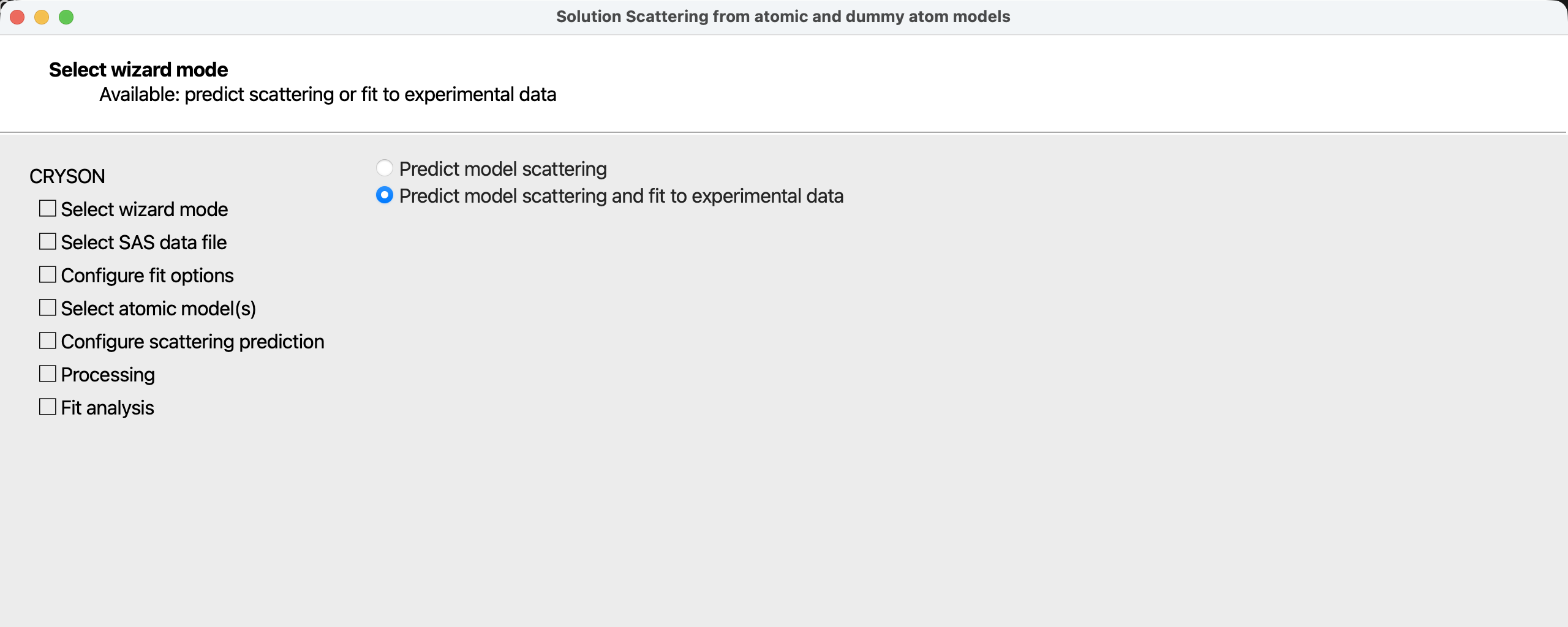 Figure 1: first page of the CRYSON wizard when started from the ATSAS Application Launcher.
As an alternative to usage from the command-line, CRYSON may also be run as a wizard from the ATSAS Application Launcher.
This graphical interface allows convenient configuration of the arguments and options outlined in the command-line section. After completion of the calculations, the produced output files can be saved.
When experimental data are provided, the graphical interface also allows the inspection of the resulting fit between the calculated model scattering and the data.
cryson Input Files
Atomic Models
CRYSON reads atomic coordinates files in .pdb format.
Experimental Data
CRYSON optionally accept background-subtracted neutron experimental SAS data (.dat).
Smearing
CRYSON may smear the theoretical curves by applying a Resolution function (.res) when fitting the experimental SANS data.
cryson Output Files
All output files start with a configurable prefix and appended suffix.
If no prefix is provided, output file names are generated based on the base name of the inputs. For example: “6lyz.pdb” generates 6lyzNN.log, 6lyzNN.int, 6lyzNN.alm, where NN is an increasing number starting from 00. This means that re-running CRYSON with the same input files, possibly using different options, does not overwrite results from previous runs, but increments NN by one instead: 6lyz00.log, 6lyz01.log, …
However, if a -prefix option is provided, the specified prefix is
used verbatim. Multiple runs then generate identical output file
names and overwrite previously generated files.
| Suffix | Type | Description |
|---|---|---|
| .log | ASCII | A copy of the screen output |
| .int | ASCII | Calculated scattering on arbitrary scale |
| .fit | ASCII | Fit of the calculated scattering curve versus the experimental data. |
| .alm | BINARY | Binary amplitudes. |
The first line of a .fit file contains the following fields:
| Field | Description |
|---|---|
| Dro | Optimal hydration shell contrast (in \(10^{10}\,\mathrm{cm}^{-2}\)). |
| Rg | Radius of gyration (in \(\AA\)) estimated from the theoretical curve. |
| Vol | Optimal excluded volume (in \(\AA^3\)). |
| Chi^2 | Discrepancy between theoretical and experimental curves. |
Examples
Intensity Calculation
Calculate the scattering intensity from an atomic model. Maximum order of harmonics = 20 and \(\text{D}_\text{2}\text{O}\) fraction = 0.5
$ cryson tr.pdb -lm 20 -D2O 0.5
Single-model fitting with smearing
Use CRYSON to calculate scattering intensities from tr.pdb.
The calculated theoretical curve is smeared using the resolution
parameters from ill.res and fitted to the experimental SANS
data in trd2o.dat.
$ cryson tr.pdb trd2o.dat --res=ill.res
Interactive Single-Model Fitting With Perdeuteration
Use CRYSON to calculate the scattering intensity from
Arp23_Active_WC_Actin.pdb in which the second chain
is 50% perdeuterated and the third chain is 100%
perdeuterated.
Note that the command-line option -per set the perdeuteration
level for all chains uniformly. To set individual values,
interactive configuration has to be used.
  ***  ------------------------------------------------  ***
  ***    C R Y S O N  W95/98/NT/UNIX version 2.7         ***
  ***    Please reference: D.Svergun et al. (1998)       ***
  ***    Proc. Natl. Acad. Sci. USA, 95, 2267-2272.      ***
  ***    Version (LMAX=50) for small and wide angles     ***
  ***        Last revised  ---  13/03/2015               ***
  ***    Copyright (c) ATSAS Team                        ***
  ***    EMBL, Hamburg Outstation, 1998 - 2015           ***
  ***  ------------------------------------------------  ***

  ------------------------------------------------
                  Program options :
  0 - evaluate scattering amplitudes and envelope
  1 - evaluate only envelope and Flms
  2 - read CRYSON information from a .sav file
   Type cryson --help for batch mode use
  ------------------------------------------------

 Enter your option ...................... <            0 >:
 Brookhaven file name ................... <         .pdb >: Arp23_Active_WC_Actin.pdb
  ------------------------------------------------
          Following file names will be used:
 Arp23_Active_WC_Actin00.log -- CRYSON log-file          (ASCII)
 Arp23_Active_WC_Actin00.sav -- save CRYSON information  (binary)
 Arp23_Active_WC_Actin00.flm --   multipole coefficients (ASCII)
 Arp23_Active_WC_Actin00.int --   scattering intensities (ASCII)
 Arp23_Active_WC_Actin00.fit -- fit to experimental data (ASCII)
 Arp23_Active_WC_Actin00.alm --   net partial amplitudes (binary)
  ------------------------------------------------
  Maximum order of  harmonics ........... <           15 >:
  Order of Fibonacci grid ............... <           17 >:
  ----------  Reciprocal space grid  -------------
   ( in s = 4*pi*sin(theta)/lambda [1/angstrom] )
 Maximum s value ........................ <       0.5000 >:
  Number of points ...................... <           51 >:
  Enter perdeuteration for individual chains
  Typing negative number indicates that the
  rest of the molecule is protonated
 Perdeuteration, chain [A] (0 y 1) ...... <        0.000 >:
 Perdeuteration, chain [B] (0 y 1) ...... <        0.000 >: 0.5
 Perdeuteration, chain [C] (0 y 1) ...... <        0.000 >: 1.0
 Perdeuteration, chain [D] (0 y 1) ...... <        0.000 >: -1.0
 D2O fraction in solvent (0 y 1) ........ <        1.000 >:
 Fraction of nonexchanged NH peptide .... <       0.1000 >:
 Read atoms and evaluate geometrical center ...
  Number of atoms read .................................. : 17970
  Number of skipped rotamers ............................ : 83
 Percent processed      10  20  30  40  50  60  70  80  90 100
 Processing atoms   :>>>>>>>>>>>>>>>>>>>>>>>>>>>>>>>>>>>>>>>>
 Processing envelope:>>>>>>>>>>>>>>>>>>>>>>>>>>>>>>>>>>>>>>>>
 Coefficients   saved to file Arp23_Active_WC_Actin00.flm
 CRYSON data    saved to file Arp23_Active_WC_Actin00.sav
 --- Structural parameters (sizes in angstroms) ---
 Atomic     Rg   :  46.28       Envelope   Rg      :  48.50
 Shape      Rg   :  49.13       Envelope  volume   : 0.4357E+06
 Shell    volume : 0.7497E+05   Envelope  surface  : 0.2351E+05
 Shell      Rg   :  59.18       Envelope  radius   :  91.83
 Shell    width  :  3.000       Envelope  diameter :  169.9
 Solvent density [10**10 cm**-2] ........ <        6.404 >:

 Molecular weight: 0.2569E+06   Dry volume         : 0.3114E+06
 Displaced volume: 0.3210E+06   Average atomic rad.:  1.622
 Solvent density :  6.404       Particle contrast  : -2.328
 Number of residuals :            2263
 Fit the experimental curve [ Y / N ] .. <          Yes >: n
 Contrast of the solvation shell ........ <       0.6404 >:
 Average atomic radius .................. <        1.622 >:
 Excluded Volume ........................ <  3.2101E+005 >:
 Average atomic volume .................................. : 17.86
 Radius of gyration from atomic structure
 Rg ( Atoms - Excluded Volume + Shell ) ................. : 53.34
 Rg from the slope of net intensity ..................... : 51.02
 Intensities    saved to file Arp23_Active_WC_Actin00.int
 Net amplitudes saved to file Arp23_Active_WC_Actin00.alm